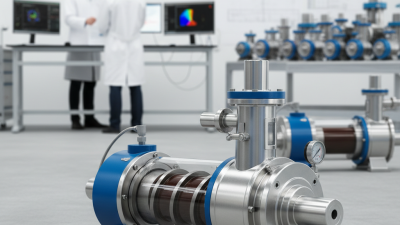
Choosing a positive displacement water pump supplier in China takes more than comparing prices. Buyers must match pump design to water quality, flow rate, pressure, and operating hours. A small mismatch can cause pulsing flow, seal wear, or costly downtime. Details matter.
For a clear engineering perspective, Igor J. Karassik is a respected pump engineer and editor of the Pump Handbook. I cannot verify a verbatim quotation from him on this specific supplier topic, so it would be misleading to invent one. A practical takeaway from his engineering legacy is: “Select the pump for the service conditions, not the catalog headline.” Treat that as a summary, not his exact words.
This overview will examine Chinese suppliers through the questions that matter on a real project: What pump types do they build? Can they document materials, performance, and quality checks? Do they support testing, spare parts, and technical communication after delivery? A clear curve and a tidy factory video help, but they are not proof of long-term reliability. Ask for model-specific data and references for similar applications. Then compare what suppliers can verify, not only what they promise. Some specifications may still be incomplete. That deserves a closer look.
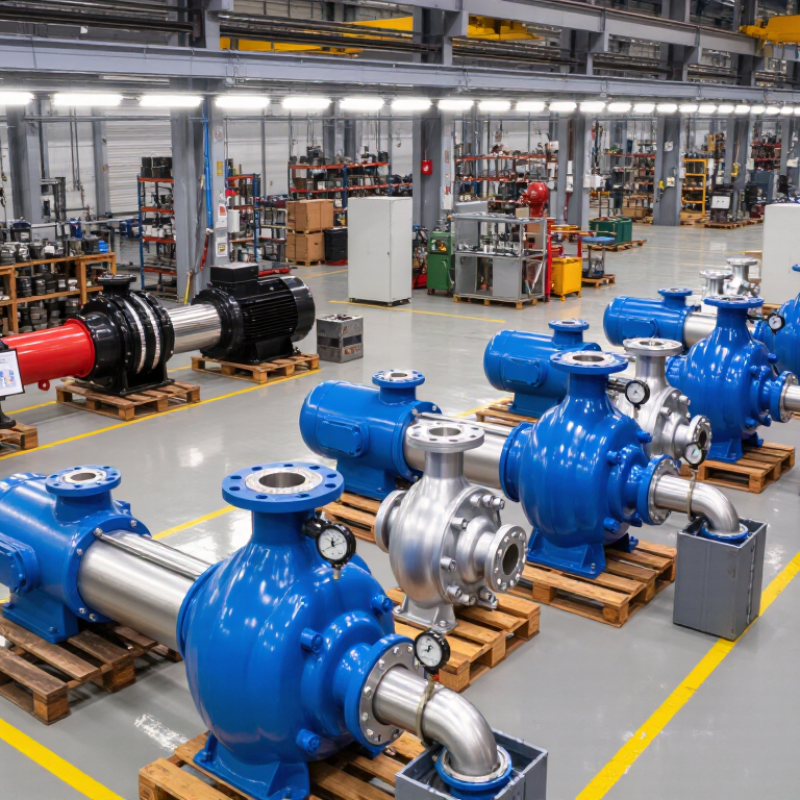
Positive-displacement pump flow is tied closely to displacement per revolution and rotational speed. A useful estimate is Q = displacement × rpm × volumetric efficiency. For example, a pump displacing 100 cm³ per revolution at 1,000 rpm delivers 100 L/min theoretically. At 90% volumetric efficiency, actual flow is about 90 L/min. A neat calculation, but not the whole story.
Pressure, fluid viscosity, temperature, and internal clearances affect leakage and actual output. If speed rises by 10%, flow usually rises by roughly 10% when conditions remain stable. Yet thin, hot fluid can increase internal slip, so the measured flow may fall short. Check the pump curve and measure flow under working conditions. Small details matter.
Energy use deserves attention, too. The U.S. Department of Energy’s Improving Pumping System Performance sourcebook reports that pumping systems account for nearly 20% of global electricity use, and can consume 25–50% of energy in some industrial facilities. Those figures cover pumping systems broadly, not positive-displacement pumps alone. Matching rpm to demand can reduce wasted circulation, but speed control must respect pressure limits and the pump’s operating range. Reality is messier.
China’s supplier landscape is easier to compare by pump type than by catalogue size. Rotary makers commonly offer gear, screw, and lobe designs for viscous fluids and steady transfer. Reciprocating makers focus on piston, plunger, or diaphragm units where pressure or accurate dosing matters. Metering specialists typically publish flow turndown, repeatability, wetted materials, and calibration procedures. These figures deserve more weight than broad claims about “precision.”
The U.S. Department of Energy’s Improving Pumping System Performance: A Sourcebook for Industry reports that pumping systems use nearly 20% of the world’s electrical energy. This is a system-wide figure, not a positive-displacement market statistic. It still makes efficiency, duty-cycle matching, and maintenance access relevant when comparing suppliers. Ask for a test curve at your actual viscosity and pressure; a water-only test may not represent the process. I would not assume a large catalogue proves strong engineering support.
Tips: Request material certificates, seal options, noise data, and a witnessed factory test. For metering units, verify calibration across the intended flow range. Check whether spare parts and service instructions are available in English. Small details matter. A supplier’s answer may be incomplete; record the gap and clarify it before purchase.
China’s positive displacement pump suppliers serve demanding industries, but the API category matters more than a broad product label. API 674 covers reciprocating power pumps, often selected for high-pressure transfer. API 675 applies to controlled-volume metering pumps, where repeatable dosing is essential. API 676 addresses rotary pumps, including screw, gear, and lobe designs. Different duties require different checks.
When comparing suppliers, match the pump type to the fluid, flow rate, pressure, and operating temperature. Ask for the proposed API edition, compliance documents, material details, and performance test records. A metering pump handling a small chemical dose has different needs from a rotary pump moving viscous oil. Review pulsation control, seal selection, and maintenance access too. A brochure alone is not enough.
Tips: Request a datasheet and test report for the exact configuration, not just the product family. Confirm what the supplier’s API claim covers, including any exclusions. Check spare-parts availability and service response before ordering. Even careful selection can miss a site-specific issue; verify operating conditions with the project engineer.
When comparing China’s positive displacement water pump suppliers, match the pump to the actual operating point, not just the largest number in a catalog. Record required flow in m³/h, discharge pressure in MPa, and the liquid’s viscosity in cP. A pump rated for 12 m³/h may deliver less at higher pressure or with a thick fluid. Ask for performance curves under conditions close to yours.
Viscosity changes more than flow. It affects motor load, inlet losses, and the clearance needed inside the pump. Share the fluid temperature and expected viscosity range, not one convenient figure. Then check whether the supplier states test conditions, motor power, and allowable pressure clearly. Small details matter. A tidy table can still omit temperature; I would treat that as a reason to ask, not proof of poor quality.
Request a test report or a witnessed factory test showing measured flow and pressure at the selected speed. Confirm wetted-part materials and seal options against your water quality and cleaning routine. Compare quotations at the same duty point, with the same viscosity and installation assumptions. If a supplier promises every point without explaining its limits, pause. Even careful estimates need a real-world check.
When comparing China-based positive displacement water pump suppliers, check the wetted parts against the actual water chemistry, temperature, and solids content. Ask for material grades, not just labels such as “stainless steel.” Confirm casing and rotor materials, elastomer compatibility, and whether abrasive particles could score close-clearance surfaces. Small details matter. Request the seal arrangement, flushing requirements, and expected leakage limits in writing. If the supplier proposes a seal plan, ask what operating conditions it assumes.
Test data should show flow, differential pressure, speed, power, test fluid, and measurement uncertainty at the duty point. Ask for the original test record, not only a polished curve. The U.S. Department of Energy’s Improving Pumping System Performance sourcebook estimates pumping systems use nearly 20% of global electrical energy demand, underscoring why verified performance matters. For rotary pump testing, compare procedures with Hydraulic Institute standard ANSI/HI 6.1–6.5. Ask how the supplier handles deviations and retesting. A tidy datasheet can still conceal a poor match; the checklist itself is not a substitute for reviewing the test conditions.
Service support deserves the same scrutiny as hardware. Request spare-parts lead times, local technician coverage, commissioning scope, and a written response-time target. Ask which parts are normally replaced during routine maintenance, and whether drawings and operating instructions arrive with the pump. One practical test: send a specific technical question before shortlisting. The clarity of the answer is useful evidence, though not proof.