What Is an Oil Pump Handle and How Does It Work?

An oil pump handle looks simple, but it controls a carefully balanced fluid-transfer process. When the handle moves, it drives a piston or diaphragm inside the pump body. Suction valves open during the return stroke, drawing oil from a container. Discharge valves open during the working stroke, pushing oil through the outlet. Small movements create steady flow.

The wider market explains its continued relevance. The International Energy Agency’s Oil 2024 report projects global oil demand to reach about 105.4 million barrels per day by 2030. The U.S. Energy Information Administration also expects petroleum liquids to remain important in global energy use for decades. These reports do not measure oil pump handles directly. They show why dependable transfer equipment still matters across workshops, farms, maintenance areas, and industrial facilities.

Igor J. Karassik, co-editor of the Pump Handbook, described pumps as “the heart of a process plant.” His point applies here, although a hand-operated oil pump is far smaller. The handle, seals, springs, and check valves must work together. A worn seal may cause leakage. A blocked intake may produce no flow. It is not complicated, but it is easy to underestimate.

This guide explains the oil pump handle’s parts, operating cycle, common designs, and practical maintenance checks. It also considers flow rate, compatibility, storage conditions, and safe handling. The details matter. A cleaner handle is not always a better pump. Performance depends on the whole mechanism.
What Is an Oil Pump Handle and How Does It Work?

Oil Pump Handle: Definition and Main Components

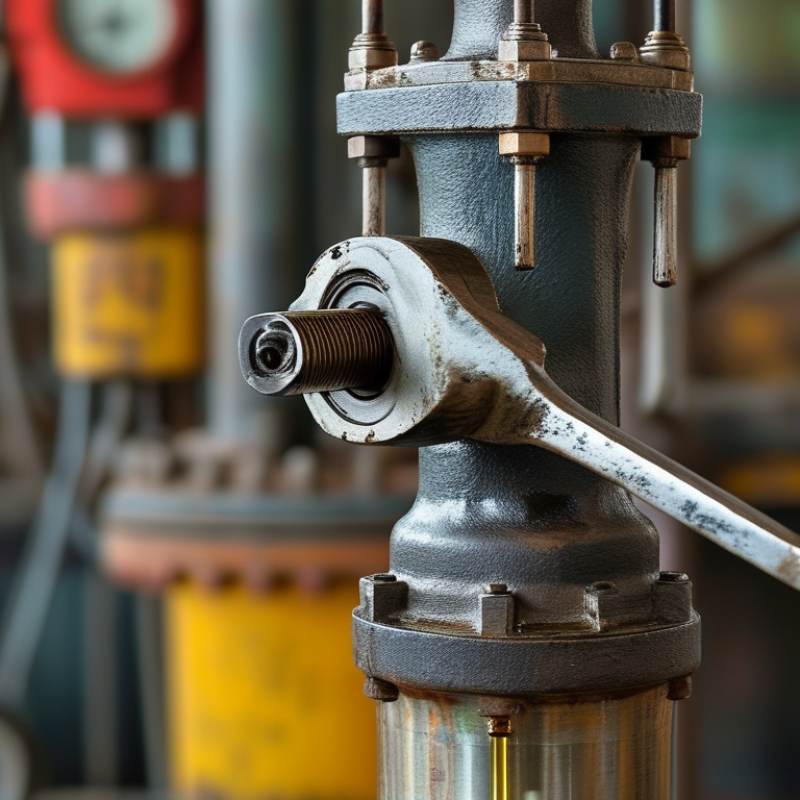
An oil pump handle is the lever used to operate a manual oil dispensing pump. It transfers hand force to an internal pumping mechanism. Most handles connect to a piston, diaphragm, or rotary shaft. The handle alone does not move oil. Its shape, length, and pivot position control the pumping effort.

The main components include the handle, pivot pin, mounting bracket, connecting rod, pump chamber, valves, and seals. The handle provides mechanical leverage. A pivot pin allows smooth movement around a fixed point. The connecting rod carries motion into the pump chamber. In piston designs, one-way valves guide oil through the inlet and outlet passages. Seals reduce leakage around moving parts. Small details matter.

When the handle rises, the chamber usually draws oil from the container or supply line. When the handle moves down, pressure pushes oil toward the delivery spout. Repeated strokes create a steady flow. The exact action depends on the pump design. Some handles operate a rotary gear instead of a piston. Pump designs vary.

A practical inspection should check the pivot for looseness and unusual side movement. Look for bent metal, cracked seals, and oil leaking near the shaft. A stiff handle may indicate contamination, worn parts, or excessive pressure in the system. The explanation is not perfect for every model, so service instructions remain important. Clean movement is a useful clue, but it does not prove that the pump is healthy.

What Is an Oil Pump Handle and How Does It Work?

Oil Pump Handle: Definition and Main Components

An oil pump handle is the lever used to manually operate a pump. Moving the handle drives a piston or diaphragm, creating pressure that draws oil through the suction passage and pushes it through the delivery passage. A basic hand-operated oil pump commonly includes one handle, one pivot, one pumping element, one cylinder, two check valves, two sealing elements, and one suction tube.

How the Handle Activates the Pumping Mechanism

What Is an Oil Pump Handle and How Does It Work?

An oil pump handle is the lever that starts fluid movement inside a manual pump. When you pull it upward, the handle lifts a piston or diaphragm. This creates lower pressure inside the pump chamber. Oil then enters through an inlet valve. Push the handle downward, and the piston compresses the oil. The inlet valve closes, while an outlet valve opens. Fluid moves through the discharge tube. One complete stroke repeats this pressure cycle.

The handle provides mechanical advantage, so your arm moves more oil than direct pressure could manage. A longer handle usually produces greater leverage, but it may require more space. In field maintenance, a smooth, firm stroke often indicates healthy seals and clear passages. A jerky movement can signal thick oil, a worn gasket, or a blocked filter. Do not ignore it.

Small details matter.

The International Energy Agency’s Oil 2024 report projects global oil demand near 105.4 million barrels per day by 2030. That scale depends on countless transfer points, including simple manually operated pumps. The U.S. Energy Information Administration also reports that petroleum liquids remain central to industrial energy use. However, report data describes market scale, not every pump’s output. I once viewed a stiff handle as ordinary resistance. It was a warning. Checking the suction tube and valve seating would have been wiser. Regular inspection reduces spills, uneven dosing, and unnecessary hand strain.

The Step-by-Step Process of Moving Oil

What Is an Oil Pump Handle and How Does It Work?

An oil pump handle controls the movement of liquid through a transfer system. The process begins with a clean container and a secure suction hose. The operator checks seals, valves, and the meter. A loose connection can draw air instead of oil.

When the handle moves, it activates a piston or rotary mechanism inside the pump. That movement creates lower pressure on the inlet side. Atmospheric pressure then pushes oil into the hose. A second stroke sends the oil toward the outlet. The operator opens the delivery valve slowly and watches the flow. The meter records the transferred volume. This step-by-step action repeats until the required amount moves safely. The handle must stop before the hose is removed.

Global demand makes reliable transfer equipment important. The International Energy Agency’s Oil 2024 report expects oil demand to reach about 103.2 million barrels per day in 2024. Even a small leak matters at that scale. API Recommended Practice 2003 also highlights controlling static electricity during petroleum handling. The practical lesson is clear, although real equipment is rarely perfect.

Tips:

Keep the handle upright when stored. Inspect the gasket before every transfer. Do not force a stiff lever. Check for air bubbles, unusual noise, or slow flow. These signs may indicate a blocked filter or worn seal. Record the volume after each operation. That small habit can reveal errors that memory misses.

Common Handle Designs and Their Applications

What Is an Oil Pump Handle and How Does It Work?

An oil pump handle transfers human force into pumping motion. Its design controls speed, torque, comfort, and spill risk. Lever handles are common on manual drum pumps. A long steel lever creates mechanical advantage. Each stroke lifts fluid through a piston or diaphragm. This design suits lubricants, hydraulic oils, and other low-to-medium viscosity fluids. It works well beside a 200-litre drum, where the operator needs controlled filling.

Rotary crank handles use repeated circular motion. They provide steadier discharge and suit thicker oils, greases, and gear fluids. Operators can feel resistance through the crank. That feedback helps identify blockage or excessive viscosity. Smaller T-handles appear on compact transfer pumps and sampling equipment. They need less storage space, but usually deliver lower volume per stroke. The U.S. Energy Information Administration reported average U.S. crude production of 12.9 million barrels per day in 2023. That scale explains the continuing need for dependable fluid-transfer hardware, even when the handle looks simple. The IEA’s Oil 2024 report projected global oil demand would reach about 104 million barrels per day in 2025. Small interface failures can therefore create repeated delays across maintenance operations. Ergonomics still deserves attention. A handle placed too close to a drum rim can scrape knuckles or reduce the stroke length. That detail is easy to overlook. In field use, technicians should match handle length, seal material, and pump geometry with fluid temperature and viscosity. The right choice is not always the fastest one.

What Is an Oil Pump Handle and How Does It Work? - Common Handle Designs and Their Applications

Handle Design How It Works Typical Pump Type Common Applications Main Advantages Important Considerations
Lever Handle The operator moves a long lever back and forth. The lever drives a piston, diaphragm, or rotary mechanism that creates suction and pressure to move oil. Manual drum pump or hand-operated piston pump Transferring lubricating oil, hydraulic oil, gear oil, and similar fluids from drums or containers Simple construction, low purchase cost, and no electricity required Flow depends on the operator; seals and moving parts require periodic inspection
Rotary Crank Handle Turning the crank rotates internal gears or vanes. The rotating elements draw oil through the inlet and discharge it through the outlet. Rotary gear pump or rotary vane drum pump Workshop oil dispensing, equipment maintenance, and medium-volume fluid transfer Provides a relatively smooth flow and can handle thicker oils better than some simple piston designs The pump must be turned in the specified direction; excessive force may damage gears or the drive shaft
T-Handle A crossbar provides a two-handed grip for operating a reciprocating piston or plunger inside the pump body. Plunger-style manual oil pump Small containers, service carts, lubrication points, and low-to-moderate volume dispensing Good hand clearance and straightforward operation in compact work areas Usually requires repeated strokes; output per stroke varies with pump size and fluid viscosity
Push-Pull Handle Pushing and pulling the handle moves a piston or diaphragm through alternating intake and discharge strokes. Reciprocating piston or diaphragm pump Portable oil transfer, field servicing, and applications where a compact operating motion is useful Compact design and easy control of the pumping rate Requires a stable mounting position; worn check valves can reduce suction and discharge performance
Ratchet Handle A ratcheting mechanism converts short, repeated handle movements into one-way rotation of a gear or piston drive. Manual gear pump with ratchet drive Restricted-access areas, heavy lubricants, and installations where a full circular crank stroke is difficult Works in limited space and can provide mechanical advantage for higher-viscosity oils The ratchet must be set correctly; the mechanism may wear if overloaded or contaminated
Removable or Locking Handle The handle attaches to a drive shaft and can be removed or locked to prevent unintended pump operation during storage or transport. Manual rotary or lever-operated oil pump Shared maintenance areas, mobile service equipment, and storage drums Improves portability and helps reduce accidental dispensing The connection point should be checked for looseness, corrosion, and correct engagement before use
Powered Actuator Handle An electric, pneumatic, or hydraulic actuator replaces manual effort and drives the pump through a controlled shaft or linkage. Powered transfer pump or metering pump Frequent dispensing, production equipment, bulk oil transfer, and systems requiring repeatable flow Reduces operator fatigue and can provide consistent flow over extended periods Requires a suitable power source, compatible controls, and safeguards against leaks or overpressure
Selection Note: Choose an oil pump handle according to the oil viscosity, required flow rate, container size, available operating space, duty cycle, and whether manual or powered operation is appropriate.

Safety, Maintenance, and Troubleshooting Basics

What Is an Oil Pump Handle and How Does It Work?

An oil pump handle is the lever that drives a manual pump’s internal piston or diaphragm. Pulling it upward creates suction, while pushing it downward moves oil through the outlet. A check valve controls the flow and helps prevent backflow. The movement should feel steady, not gritty or unusually loose. Small details matter.

Small details matter.

Safety begins before pumping.

Place the equipment on stable ground, keep the nozzle away from ignition sources, and wear oil-resistant gloves and eye protection.

The U.S. Bureau of Labor Statistics recorded 87 fatal occupational injuries in oil and gas extraction during 2022.

That figure supports a simple lesson: routine tasks still require controlled procedures.

Never use excessive force or stand over a pressurized connection. A clean handle is not automatically safe.

Inspect the pivot, fasteners, seals, hose, and delivery spout during every service check.

Wipe away spilled oil because it can hide cracks and create a slipping hazard. Lubricate only where the equipment instructions permit it.

If the handle moves but no oil appears, check the fluid level, suction seal, clogged filter, and closed valve.

If flow pulses, air may be entering through a loose fitting.

Stop immediately when oil leaks near the handle or the lever jams.

API Recommended Practice 54 emphasizes hazard assessment, equipment inspection, and safe operating procedures for oilfield work.

In practice, troubleshooting is sometimes rushed. That is a mistake worth correcting.